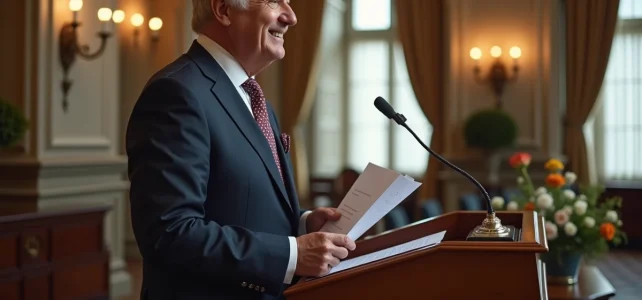
The mayor’s speech at a civil wedding is not an exercise in free style. It is a civil act framed by the Civil Code, to which the officiant can add a personalized address. Confusing the two registers results in a wobbly speech, either too solemn or too familiar. Here, we detail the technical and editorial points that general guides often overlook.
Mandatory mentions of the Civil Code and real leeway
Before any personalization, the civil registrar must adhere to a legal foundation. The reading of the articles of the Civil Code is not optional: articles 212, 213, 214 paragraph 1, 215 paragraph 1, and 371-1 are mandatory passages. They remind of the mutual duties of respect, fidelity, support, and assistance, the joint direction of the family, the contribution to the marriage expenses, and the community of life.
The margin for personalization occurs around this legal core, never in its place. Specifically, the officiant has two slots: the opening address (before the reading of the articles) and the closing word (after the consent and the signing of the registers). Some municipalities publish internal guidelines asking future spouses to provide a text introducing the couple or biographical elements to enrich these free parts.
Writing a mayor’s speech for a wedding thus requires structuring the message by clearly distinguishing the legal sequence from the personal sequence. Mixing the two undermines the solemnity of the act and creates a confusion of registers for the guests.
Structuring the mayor’s personalized address
An effective civil wedding speech relies on three distinct blocks, each with its specific function.
Opening: anchoring the moment
The opening names the couple, greets the families, and situates the ceremony within the municipality. We recommend not exceeding three or four sentences. Mentioning the location (the town hall, the wedding hall) and the date creates a solemn anchor without unnecessary emphasis.
Body: what makes this couple unique
This is the block where personalization takes on its full meaning. Two approaches work well:
- The factual narrative of the couple: how they met, how long they have been together, a common project that defines them. These elements are generally provided by the couple themselves during the preparatory meeting at the town hall.
- A short literary quote or reference, chosen in echo to the couple’s personality. A verse, an excerpt from correspondence, never more than two lines. Multiplying quotes turns the address into an anthology.
- The evocation of a shared value (associative commitment, common professional background, connection with the municipality) that adds substance without veering into private anecdotes.
The body of the speech should not exceed half of the total time of the address. Beyond that, the guests’ attention wanes, especially in a civil status room where the acoustics are rarely optimal.
Closure: the formula of consecration
After mutual consent and the signing of the registers, the officiant pronounces the official declaration of union. This moment is codified. The personal word that follows, if it exists, should remain brief: a wish addressed to the couple, a phrase of congratulations. Nothing more.
Adapting the tone of the civil wedding speech to the context
The register of language depends on several parameters that we often see neglected. An overly formal speech at a casual wedding creates a mismatch as awkward as the reverse.
The first parameter is the profile of the couple. A young couple organizing a rustic reception does not expect the same vocabulary as a couple renewing their vows for a golden anniversary. The latter case is, in fact, a distinct practice: several municipalities offer vow renewal ceremonies with a tailored speech, more retrospective and focused on the duration of the commitment.
The second parameter is the identity of the officiant. The incumbent mayor, a delegated deputy, or a qualified municipal councilor do not have the same relationship with the constituents. A deputy who personally knows the couple can afford a measured touch of humor. An officiant meeting the couple for the first time on the day gains by remaining in a warm but sober register.

Common mistakes in writing a mayor’s speech
We observe recurring flaws in civil wedding addresses, even among experienced elected officials.
- Drowning the consent in the speech. The request for consent is a precise legal act. It should not occur amidst a lyrical outburst, but in silence, after a clear transition.
- Reading a generic text without any mention of the names or the story of the couple. The couple and their loved ones immediately perceive a one-size-fits-all speech.
- Quoting extensively from authors unrelated to the couple. A quote from Victor Hugo or Saint-Exupéry adds nothing if it does not resonate with a concrete element of their journey.
- Exceeding a reasonable duration. The personalized address, excluding the reading of the articles of the Civil Code and formalities, works better when kept under a few minutes. A concise and sincere speech leaves a stronger impression than a long and conventional one.
Ultimately, writing a mayor’s speech for a wedding rests on a simple balance: rigorously respecting the legal framework, personalizing with restraint and sincerity, and calibrating the tone to the couple rather than a generic model. Municipalities that provide a questionnaire to future spouses in advance greatly facilitate this personalization work.