
An undersized pantry becomes a cluttered closet in just a few months. An oversized pantry eats up valuable square meters in the living room or kitchen. Determining the ideal surface area of a pantry relies on a precise calculation that takes into account the household composition, the type of equipment to be integrated, and the circulation constraints imposed by current regulations.
DTU and RE2020 Constraints: What Determines the Surface Area of the Pantry
The update of DTU 60.1 in December 2025 sets a minimum surface area of 2.5 m² for pantries in energy renovation subsidized through MaPrimeRénov’. Beyond this threshold, aids exceeding 5,000 euros require PMR accessibility, which alters the passage width and turning radius to be considered.
In terms of new construction, RE2020 pushes designers towards compact pantries, often under 4 m², to preserve the thermal envelope of the building. The gains in insulation are real, but they require denser storage. A 3 m² pantry in RE2020 must compensate for what it loses in floor space through height and modularity.
We recommend checking the detailed technical program of the builder before validating the surface area. A pantry placed against an uninsulated exterior wall degrades the Bbio coefficient, which may force a reduction in its surface area or an enhancement of insulation, both options impacting the budget. To go further, consult our guide on the ideal surface area of a pantry.
Calculation Method for Pantry Surface Area According to Equipment
The usable surface area of a pantry is not calculated in gross m². It is broken down into three zones: fixed storage, appliances, and circulation. A common mistake is to add up the floor footprints of the furniture without including the clearances necessary for door openings and loading appliances.
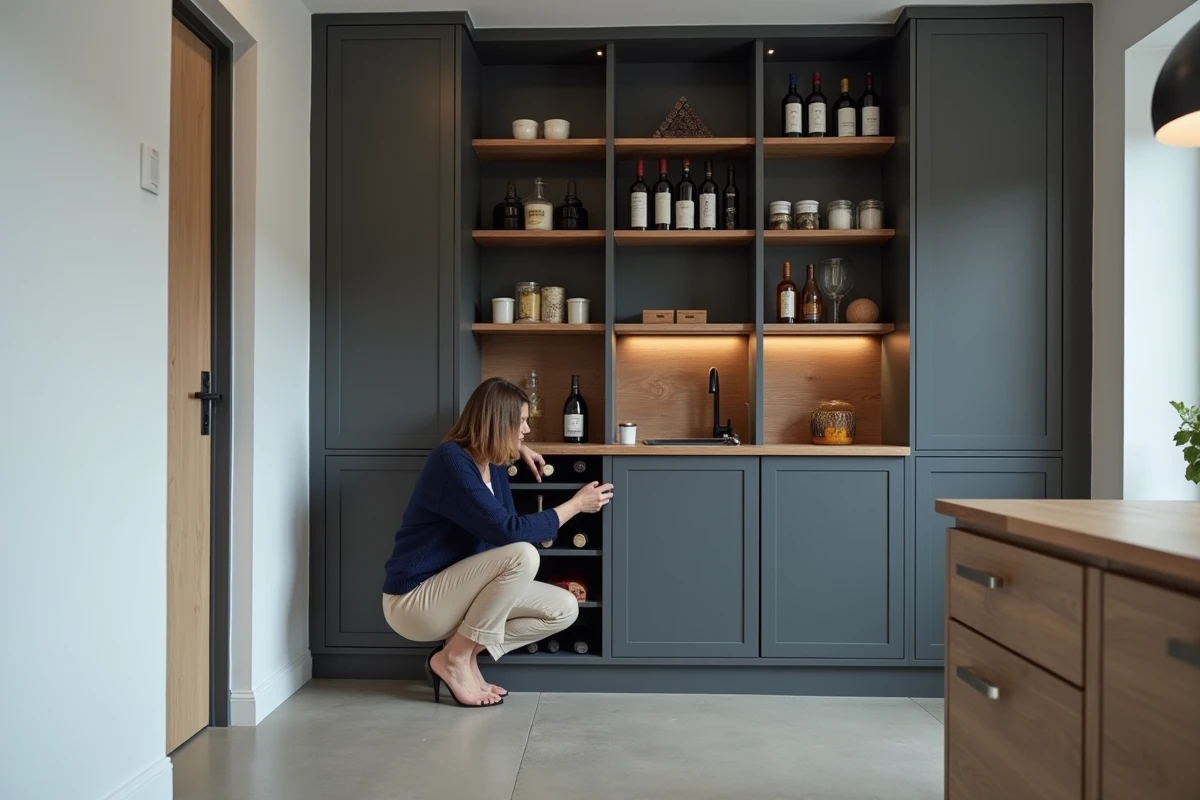
Floor Footprints and Technical Clearances
A chest freezer requires about 90 cm of front clearance to open the lid and lean inside. A front-loading washing machine needs 70 to 80 cm in front of the door. These clearances are not shareable if the appliances face each other.
For shelves, a depth of 30 to 40 cm covers most uses (canned goods, jars, cleaning products). Beyond 50 cm of depth, items at the back become inaccessible and the space is wasted.
Minimum Width and Circulation Axis
The minimum functional width is 120 cm: 30 to 40 cm for a storage line on one side and 80 cm for the passage axis. Below this, the pantry becomes a corridor where one cannot turn around or handle a grocery box. With storage on both sides, we move to a minimum of 180 cm.
- Linear pantry (storage on one wall): 120 cm wide, surface starting from 2.5 m²
- L-shaped pantry (storage on two adjacent walls): 150 cm wide on the short side, surface starting from 3.5 m²
- U-shaped pantry (storage on three walls): 180 cm wide, surface starting from 5 m²
Pantry Surface Area Adapted to Household Composition
The size of the household affects storage volume much more than the size of the house. A couple without children who cooks little does not have the same needs as a family of five that shops in bulk once a week.
The IFOP survey for Leroy Merlin published in April 2026 shows a marked preference for pantries of 3.5 m² among single-parent households, a format that allows for the integration of compact appliances and weekly food stock without spatial overload.
For a household of three to four people, we find that a pantry of 4 to 6 m² offers the best compromise between storage and circulation fluidity, provided that modular shelves are integrated up to the full height of the ceiling.

Pantry-Laundry Room Trade-off: Combine or Separate
Combining a pantry and laundry room in the same space is tempting to save surface area. The trap: the clearances for the washing machine and dryer alone consume more than one square meter, and vibrations during the spin cycle can weaken jar shelves if they are fixed to the same wall.
Separating the two functions remains preferable below 5 m². Beyond that, combining works as long as the laundry area and food storage area are visually separated, even if only by a perpendicular shelf.
Ceiling Height and Vertical Use of the Pantry
Most guides focus on floor area. However, ceiling height represents the most cost-effective lever to gain storage without expanding the footprint. A standard 3 m² pantry with 2.50 m of ceiling height offers 7.5 m³ of volume. Switching to shelves up to 2.20 m (with a step stool) significantly increases storage capacity compared to shelves limited to 1.80 m.
- Lower level (0 to 80 cm): heavy equipment, appliances, beverage crates
- Middle level (80 to 160 cm): everyday products, canned goods, dry groceries, cleaning products
- Upper level (160 to 220 cm): seasonal items, rarely used small appliances, long-term reserves
Each level corresponds to a different access frequency. Placing everyday items between 80 and 160 cm reduces unnecessary movements and limits the need for a step stool.
A final often-overlooked point: ventilation. A pantry storing food items needs a low air intake and a high outlet to avoid condensation. In a compact pantry, the VMC network or ventilation grille can occupy the space intended for a high shelf. It’s better to anticipate this from the planning stage than to discover the problem at the time of installation.